The 12,000-Year-Old Pantry: What a Dig in Chile Found Beside the Fire
In the cool rainy south of Chile, a peat bog kept what the air would have rotted: wood, hide, and the plants a settlement left behind. Among the leaves is one people still brew after dinner today, and it had lain there more than twelve thousand years.
Ask who invented tea, and the answer comes back fast, and it comes back Chinese: an emperor, a breeze, a few leaves that drift into a pot of boiling water. It is a good story. It is almost certainly not true, at least not the way a historian means the word.
What follows is the more interesting version. Not who invented tea, but the oldest place where we can stand and say: here, people kept the plants they steeped. That place is not in China. It is a peat bog in southern Chile, and one of the plants they left behind is still brewed after dinner today.
The emperor and the leaf
By the version nearly every tea book opens with, tea was discovered by Shennong, the Divine Farmer, a mythic ruler of Chinese antiquity, some five thousand years ago. As the legend is usually told, he was boiling water in the shade when leaves from a wild Camellia sinensis blew into his pot. He drank the result and tea was born. The date often attached to it, 2737 BCE, carries the false precision legends tend to pick up on the way down the centuries.
Shennong is a figure of myth, not a man with a birth record, and the earliest surviving text to treat tea seriously, Lu Yu's Classic of Tea, was written thousands of years after the emperor is supposed to have lived. The story is real as a story: it tells us China has revered the leaf for a very long time and built a founding myth around it. What it does not do is mark the first time a human being gathered a plant to steep. For that, you set the legend down and look at what came out of the earth.
A dig in a Chilean bog
In 1976, workers near Puerto Montt, in the cool rainy south of Chile, noticed bones and wood eroding from the banks of a creek called Chinchihuapi. What the archaeologist Tom Dillehay and his team uncovered there over the following decade became one of the most argued-over sites in the Americas, and, in the end, one of the most accepted. The place is called Monte Verde.
The bog had done something rare. It sealed a settlement under waterlogged peat and shut out the oxygen that rots organic things. So wood survived. Hide survived. Hearths, cordage, the frames of shelters, and, most unusual of all, plants. By the radiocarbon dating the scholarship now broadly accepts, the main occupation layer is roughly fourteen and a half thousand years old, older than the Clovis culture long assumed to mark the first Americans, and among the oldest securely dated human sites on either American continent.
Among the plant remains the excavators recovered were leaves of boldo. They turned up in chewed cuds and in a bundle of some two dozen species, and the researchers who studied the assemblage read it, from how the same plants are used in Chile today, as a medicinal one. Set that interpretation aside a moment. More than twelve thousand years ago, before pottery, before farming, before the emperor of the legend was even imagined, people at the far end of the world were already choosing particular plants, carrying them, keeping them close by the fire. Boldo was one they chose.
One caveat: at Monte Verde the boldo was chewed and bundled, not brewed in a pot. Steeping it in hot water is a later habit. The bog shows plants people kept, not a steeped cup.
What boldo is
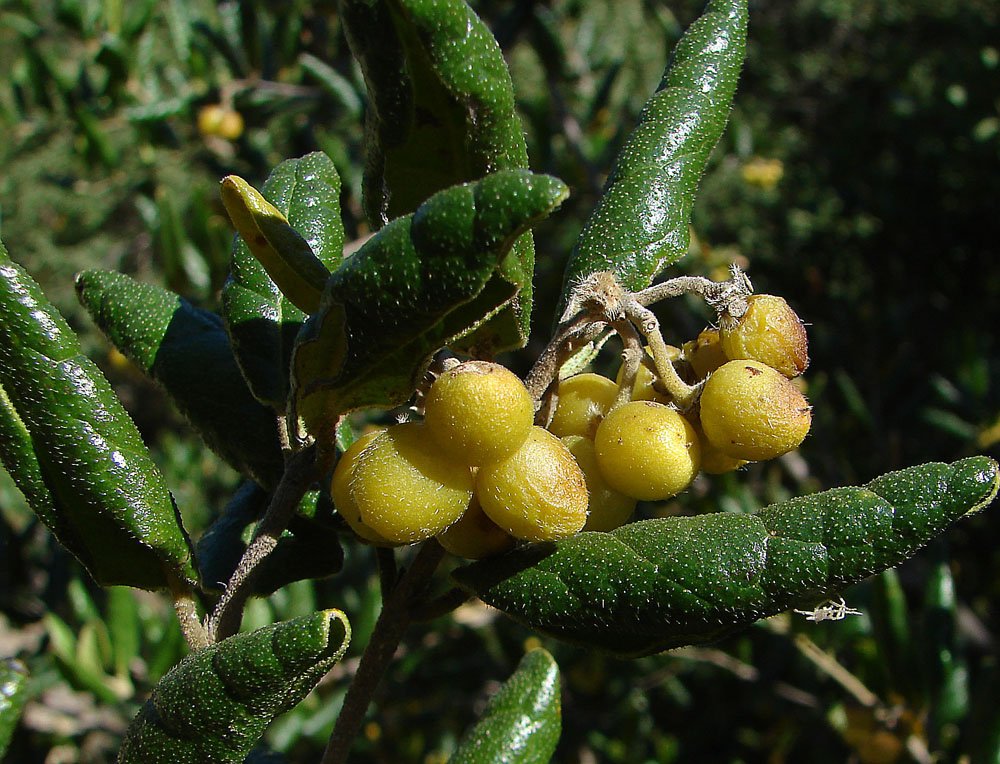
Boldo (Peumus boldus) is an evergreen tree native to central Chile, where it grows across the matorral, the dry, sun-hardened scrubland of the country's Mediterranean middle. Almost all of it is still gathered wild. Crush a leaf and you understand why people have never left it alone: a sharp, cooling, resinous scent, camphor and lemon and something faintly medicinal, closer to a bay leaf than to anything in an ordinary tea aisle.
That aroma makes boldo one of the more polarizing leaves you can put in a cup. We have written about boldo's difficult flavor elsewhere. On its own it is bracing and a little austere. In company, folded among sweeter and rounder botanicals, it turns from a curiosity into the backbone of a very old kind of after-dinner cup.
The leaf after the meal
Because that is what boldo has mostly been, for as far back as anyone can trace: an after-meal leaf. Across Chile and up through the Andean countries, a cup of boldo, alone or steeped with other herbs, is what you reach for at the end of a heavy plate, the way other tables reach for mint, fennel, or a small strong coffee. It is a domestic, unbranded, ancient habit, the kind of homemade brew Spanish speakers call a menjunje: a concoction, put together by hand. The history of herbal tea is really a history of thousands of these, made at kitchen tables long before anyone thought to sell them.
Boldo is a firm, leathery leaf, and it gives up its flavor slowly. It needs fully boiling water and a long steep, nothing like the quick dip a green tea will tolerate. Rush it and you get almost nothing. Our brewing notes lay out the timings blend by blend.
A leaf with twelve thousand years behind it
Boldo is the base of Rooted, our caffeine-free after-meal blend. It sits low in the cup while ginger, black mint, turmeric, moringa, guanábana leaf, and pineapple do the bright, forward work. The result pours an intense translucent yellow and tastes, to most people's surprise, fruity and fresh rather than medicinal: pineapple leading, the boldo cooling underneath. It is close kin to the leaf people carried out of that Chilean bog, brewed for the same moment of the day.
One caution: boldo is a traditional after-meal leaf that, by long custom, is not taken during pregnancy, and Rooted contains it. If that applies to you, it is an easy blend to skip. Gather, also caffeine-free, carries no boldo.
Rooted brews at 8g to a large mug of freshly boiled water, 10 to 11 minutes.
Menjunjes
Notes and sources.
The Monte Verde findings rest on peer-reviewed archaeology: Tom Dillehay's site monographs, the 2008 Science paper on the settlement's plant and seaweed remains, and later reassessments of the radiocarbon dates in journals such as Antiquity. These date the main occupation to roughly fourteen and a half thousand years and the boldo remains to more than twelve thousand years. The excavators read the plant bundle as medicinal; that reading is their interpretation of the assemblage.
The Shennong story is a legend, repeated in tea histories and traceable to classical Chinese tradition, not to any record from the emperor's supposed lifetime. Botanical details for boldo, its range in central Chile, its wild harvest, and its aromatic character, follow standard botanical and horticultural references. For more on the surprising modern history of tea in this part of the world, see our account of how tea came to grow below Cusco. Photograph of the boldo plant by Dick Culbert, via Wikimedia Commons (CC BY 2.0).