The Busiest Ingredient in the Tea Aisle Doesn't Have a Name
Two words near the bottom of the box can stand in for a great many ingredients you will never see listed. What "natural flavors" covers, and how to read a tea panel in about ten seconds.
Pick up almost any flavored tea, turn the box over, and read down to the small print. Somewhere near the end of the ingredient list, usually after the tea and a couple of things you recognize, sit two words: natural flavors. They take up less room than "hibiscus." They are often the reason the tea tastes the way it does.
That short phrase is one of the most-used ingredients in the aisle, and it does far more than its two words suggest.
One phrase, a great many things
Under federal labeling rules, "natural flavor" is a defined term, and the definition is broader than most people expect. It covers the essential oil, extract, essence, distillate, or similar concentrate drawn from a fruit, vegetable, herb, bark, root, leaf, spice, or other plant or animal source, whose main job in the food is to flavor it rather than to nourish it.
Two things follow from that, and both matter at the shelf.
First, "natural" here describes origin, not simplicity. A natural flavor begins with an orange, a strawberry, a vanilla pod, but what reaches the tin is a concentrated extract of that source, sometimes carried in a solvent and standardized from batch to batch so the taste never wavers. It is natural in the legal sense and processed in the practical one.
Second, the label is allowed to gather all of it under that single collective term. A flavor can be built from dozens of constituents, and they need not be broken out line by line. None of that is unusual or against the rules. It is simply how the rule is written, and once you know the phrase is there, you start to notice it on nearly every box.
Why flavored tea reaches for it
The tea aisle leans on flavoring for two practical reasons: weight and shelf life.
Real fruit is heavy, wet, and quick to fade. By most accounts from people who blend tea for a living, dried peel and berries lose their aroma fast, add cost and bulk, and shorten the life of the blend they sit in; it can take an enormous quantity of fruit to yield the few drops of oil that carry a scent. A concentrated flavor answers all of that at once. It is light, stable, inexpensive by comparison, and identical from one batch to the next. If you want a strawberry tea that still smells of strawberry a year from now, flavoring is the direct way there.
So the phrase is not a warning sign. Plenty of good, careful teas use natural flavoring and list it on the panel.
How to read a tea panel
One habit is worth taking into the aisle. It costs about ten seconds.
Ingredients are listed by weight, most to least, so the order tells you where a recipe's center of gravity sits. Read from the top and ask three questions:
- What comes first? On a tea, you generally want a leaf or botanical at the top of the list, not sugar and not a flavor.
- How much can you picture? Run down the line and count the things you could recognize on a table, an apple, a cinnamon stick, a chamomile flower, against the things you cannot.
- Where does the catch-all sit, and how large is it? "Natural flavors" high on a short list supplies most of the taste. The same phrase low on a long list of named botanicals is doing a smaller, supporting job.
None of those questions is an accusation. They are just a way to see what is in the cup.
The difference is easiest to feel with two panels side by side. One flavored black tea might read, in full: black tea, natural flavors. Two ingredients, one of them the catch-all, and the fruit you taste lives inside that second phrase.
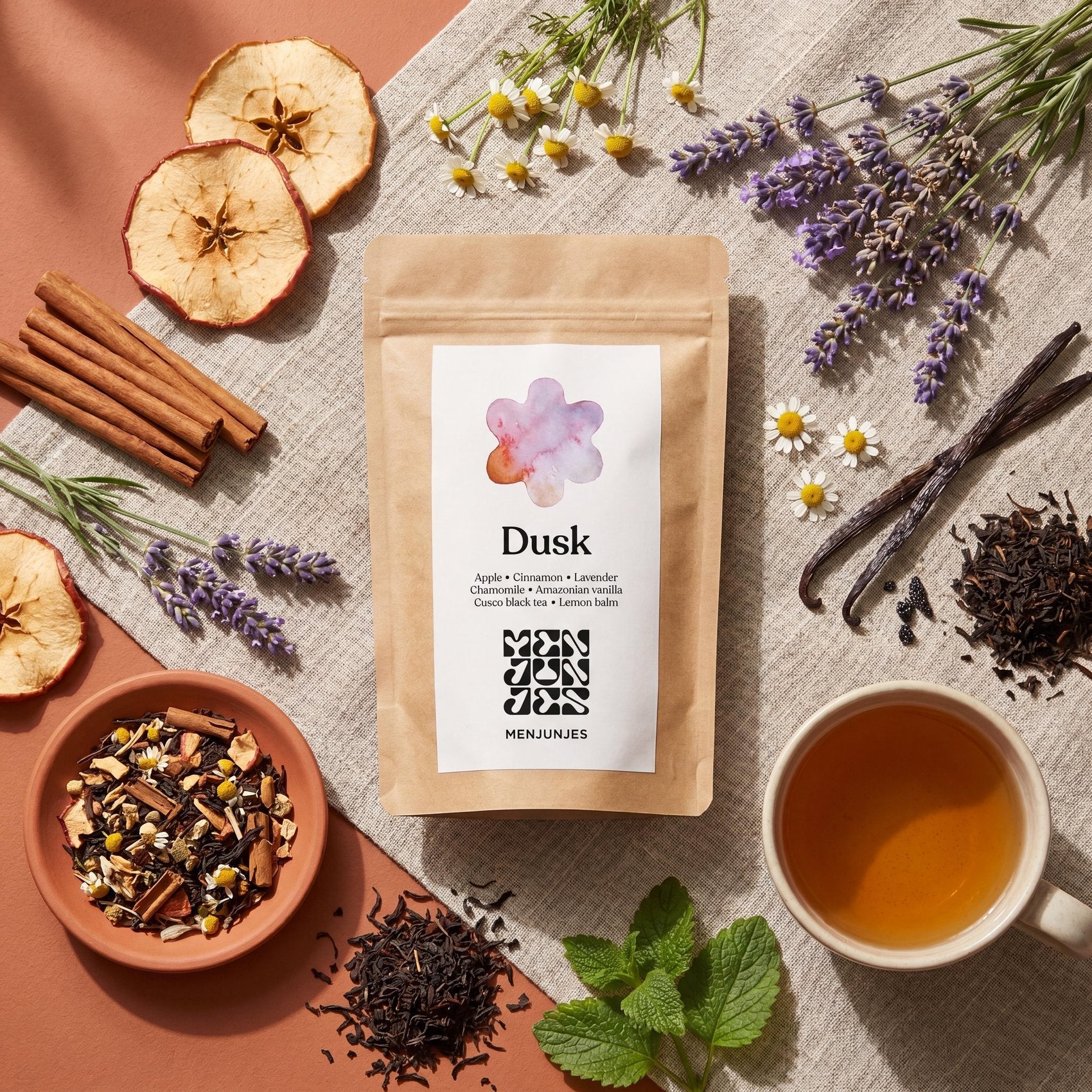
The panel for Dusk, our evening blend, reads in full: apple, cinnamon, lavender, chamomile, Amazonian vanilla, Cusco black tea, and lemon balm, the herb Peruvians call toronjil. Seven lines, and every one is a thing you could hold. The apple is apple. The vanilla, the most precious thing in the blend, is an Amazonian pod. The spice is cinnamon you could picture on a shelf. What you read is close to what you taste: a light-brown cup, gently sweet, spiced and woody, with a thread of honey and a slight, welcome astringency on a long finish.
Neither panel is better than the other. They differ in how much they itemize: one names every ingredient, the other folds the fruit into a single phrase. You can now tell which is which, on any box you pick up.
Read the back of the box
We would rather you did. The panel is the one part of the package that cannot lean on adjectives; it has to name what is inside, in order, by weight. Learn to read it and no marketing line gets past you. For a companion habit, there is a related piece on what a "made in" line does and does not promise, another small skill for the back of the box.
Menjunjes
The legal definition is paraphrased from 21 CFR 101.22; the account of why flavored tea leans on concentrated flavoring reflects the working knowledge of tea blenders and flavor houses; the Dusk panel is our own, listed as it appears on the tin.