How to Read a Tea Label
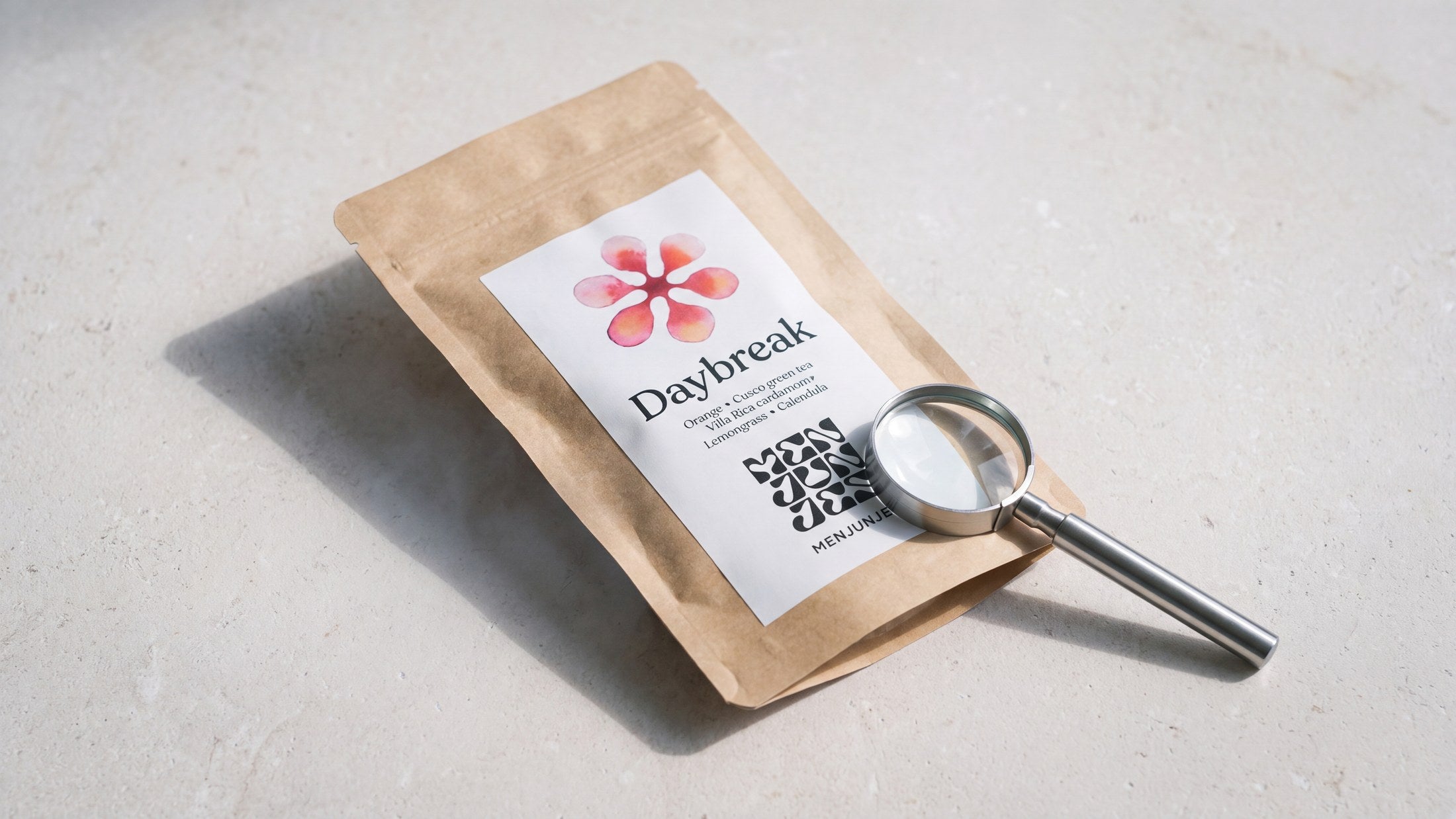
A tea label makes two kinds of statements: the ones a regulator checks, and the ones nobody does. The watercolor mountains, the word artisanal, the tasting notes that promise a feeling — all of that lives in the second category. The first category is smaller and far more useful, and on most boxes it comes down to three lines: the origin line, the name-and-address line, and the ingredient panel. They take about a minute to read. We go through each, with our own pouch as the specimen.
What an origin line verifies
Start with the line everyone notices. US customs law requires imported goods to be marked with their country of origin, meaning the country where the product was made or last substantially transformed. That last phrase carries more weight than it sounds: an origin line describes the finished product, not the ingredients inside it. A tin marked Packed in Germany can hold leaf from three continents and be telling the legal truth. The line is honest; it is simply answering a narrower question than the one most shoppers think they are asking.
Every Menjunjes pouch carries what US law asks of imported food: the country of origin, printed plainly (Made in Peru), and the name and address of the company that stands behind it. Taken literally, the origin line means this: the blends are blended and packed in Peru, then imported to the US for distribution. Some ingredients are Peruvian by origin (Cusco tea, Villa Rica cardamom, camu camu, Amazonian vanilla); others, like butterfly pea flower, are sourced globally and blended in Peru. The pouch panel names which is which. Written out in full, the line reads: "Blended in Peru. Ingredients include Peruvian and globally sourced botanicals."
The small words beside the name
The name-and-address line shows which firm is accountable for the food, and whether it made that food or only sold it. Federal food-labeling rules require every packaged food to carry the name and place of business of a responsible firm, and when that firm did not make the food itself, the rules ask that the name be qualified: manufactured for, distributed by. Those two or three small words tell you whether the company on the front of the box ever handled the tea. On a supermarket blend they usually sit in six-point type near the barcode, and they are often the most candid sentence on the package.
Reading the ingredient panel
The panel is the one part of a label that must name what is physically inside, listed in descending order by weight. It is also where a legal category called natural flavors can obscure what is inside. The term tells you a flavor was derived from something natural; it does not tell you which plant, or how many. A box can promise peach on the front and disclose only natural flavors on the back, and both statements can be true at once.
A panel can also simply name its plants. A sampling from across our four blends: Boldo. Black mint. Camu camu. Butterfly pea flower. Lavender. Lemon balm. Villa Rica cardamom. Each label prints its full list, plant by plant; nothing hides behind "natural flavors." Some of those names hold more history than a panel has room for: boldo is the leaf of mate de boldo, the after-meal cup in Chile and Peru, and camu camu is picked by canoe in the Amazon's high-water season, when the bushes stand half-submerged. A named plant can be checked, against the cup and against the record; a flavor term cannot.
What a seal proves
Certification marks confirm something specific, though less than their prestige suggests. A seal verifies a process against a published standard, audited by an accredited third party: how a crop was handled, not how it tastes, and not who grew it or where. No seal names a farm, a valley, or a plant, because a standard has to be written broadly enough to fit a soybean field and a tea garden alike. We have taken the biggest of them apart in its own piece, on what the organic seal verifies. The short version: a seal and a panel answer different questions, and a careful buyer reads both.
The label as a document
The three words Cusco green tea on Daybreak's panel carry a century of history: a seed said to have crossed the Pacific in 1913, a severe contraction and cooperative collapse in the early 2000s, a revival that earned recognition in Paris in 2023. We have told that story in full. And if the easiest way to learn a label is to live with one for a while, the Discovery Box holds all four blends in fifty-gram pouches: four labels and about twenty-five cups to find out which one is yours.
The labeling rules come from US customs law and the federal food-labeling code; each Menjunjes ingredient's stated origin is drawn from the blend specifications printed on the pouch panel, and the Cusco tea history from the sourced account linked above.
Menjunjes