What's a Menjunje? The Thousand-Year Story of the Word on Our Pouch
Menjunje is a Spanish word with an Arabic root, a 1609 use by a Cusco-born writer, and a 1734 dictionary entry that quotes him.

People usually ask what Menjunjes means before they ask what is in the pouch. In Spanish, a menjunje is a concoction: several ingredients mixed together. At Menjunjes, it names the homemade botanical kind.
Say it once: men-HOON-hes.
The word comes from Arabic. In 1609, Cusco-born Inca Garcilaso used menjurges in the Comentarios Reales. In 1734, the Academy recorded MENJURGE and quoted him. The entry’s only quoted authority was a writer from Cusco.
The Arabic root
The word begins in classical Arabic with the verb mázaǧa, to mix. Its participle, mamzūǧ, means the mixed one: a thing made by combining other things.
The Real Academia Española traces mejunje through Andalusi Arabic mamzúǧ back to classical Arabic mamzūǧ, "mixed."

From Arabic into Spanish
From 711 to 1492, Arabic and the Romance speech that became Spanish lived side by side on the Iberian peninsula, and Arabic left Spanish thousands of words. Many are kitchen words: azúcar (sugar), aceite (oil), albahaca (basil).
Somewhere in that long exchange the word passed into Spanish, and its sounds wore down over the centuries: mamzûǧ, menzuje, menjuje, menjunje.

A written example from 1568
The earliest known appearance on paper belongs to Juan de Mal Lara, a Sevillian humanist, who wrote it as menjurgue in 1568. Sevilla was then the main port for everything bound to the Americas.

Garcilaso uses menjurges
Inca Garcilaso de la Vega was born in Cusco in 1539, the son of a Spanish conquistador and an Inca noblewoman. He spent his adult life in Montilla and Córdoba, in Spain, writing about the country he had left. On the title page of his Comentarios Reales de los Incas (1609) he identified himself as natural del Cozco: a native of Cusco.
Around 1608, working from memory, he wrote menjurges to describe the simmered plant mixtures of the Andes. He is the earliest American-born writer in the word’s paper trail, and he wrote it in Spain, from memory of Peru.

The Academy records MENJURGE
When the Real Academia’s first dictionary, the Diccionario de Autoridades, reached the letter M in its fourth volume in 1734, it recorded the word under the spelling MENJURGE. Autoridades backed every entry with a quotation from a writer who had used the word well. For MENJURGE it quotes exactly one authority: Inca Garcilaso, in the first part of the Comentarios Reales, in a passage about Andean women dyeing their hair over a cauldron of simmering menjurges.
The definition is worth quoting: "Mezcla de diversos ingredientes, en bródio y mal guisados. Es voz del estilo familiar." A mixture of assorted ingredients, roughly stewed; a word of the familiar register. The dictionary was a little rude about it.
The spelling Garcilaso used and the dictionary printed, menjurge, is today marked incorrect by the same institution.

Three spellings in use
Today the word has three regional forms. Spain, in its cultured register, writes mejunje. The Southern Cone and much of South America write menjunje. Venezuela, Mexico, and much of Central America write menjurje. The meaning holds in all three: several ingredients, mixed together.
We use the southern spelling. It is on the pouch.
Similar mixtures, different traditions
Menjunje names a kind of mixing, and other traditions keep their own versions. In Argentina and Uruguay, mate passes around the table in a single gourd with one bombilla. In Morocco, mint tea is poured from a height. In Mexico, hibiscus steeps into agua de jamaica. In France, a lime-flower tisane often ends dinner.

Emoliente in Peru
In Peru, a mixed brew is part of the morning economy. The emoliente cart sells toasted barley, flaxseed, and herbs, mixed to order at dawn and poured steaming into a glass. In 2014, Peru formally recognized emoliente vendors in law as micro-entrepreneurs. The vendors’ federation says the trade sustains more than a hundred thousand families, and that three in four of the people behind the carts are women.

Why the name is on the pouch

At Menjunjes, the word names four botanical blends, blended in Peru: Daybreak for mornings, Rooted after meals, Dusk in the evening, and Gather when people come over.

What’s your menjunje? If your family had one, tell us what went into it and what you called it.
Batch 001 is live. The Discovery Box holds all four: about 25 cups across the set, $40, with a pour card for each blend.
Image credits
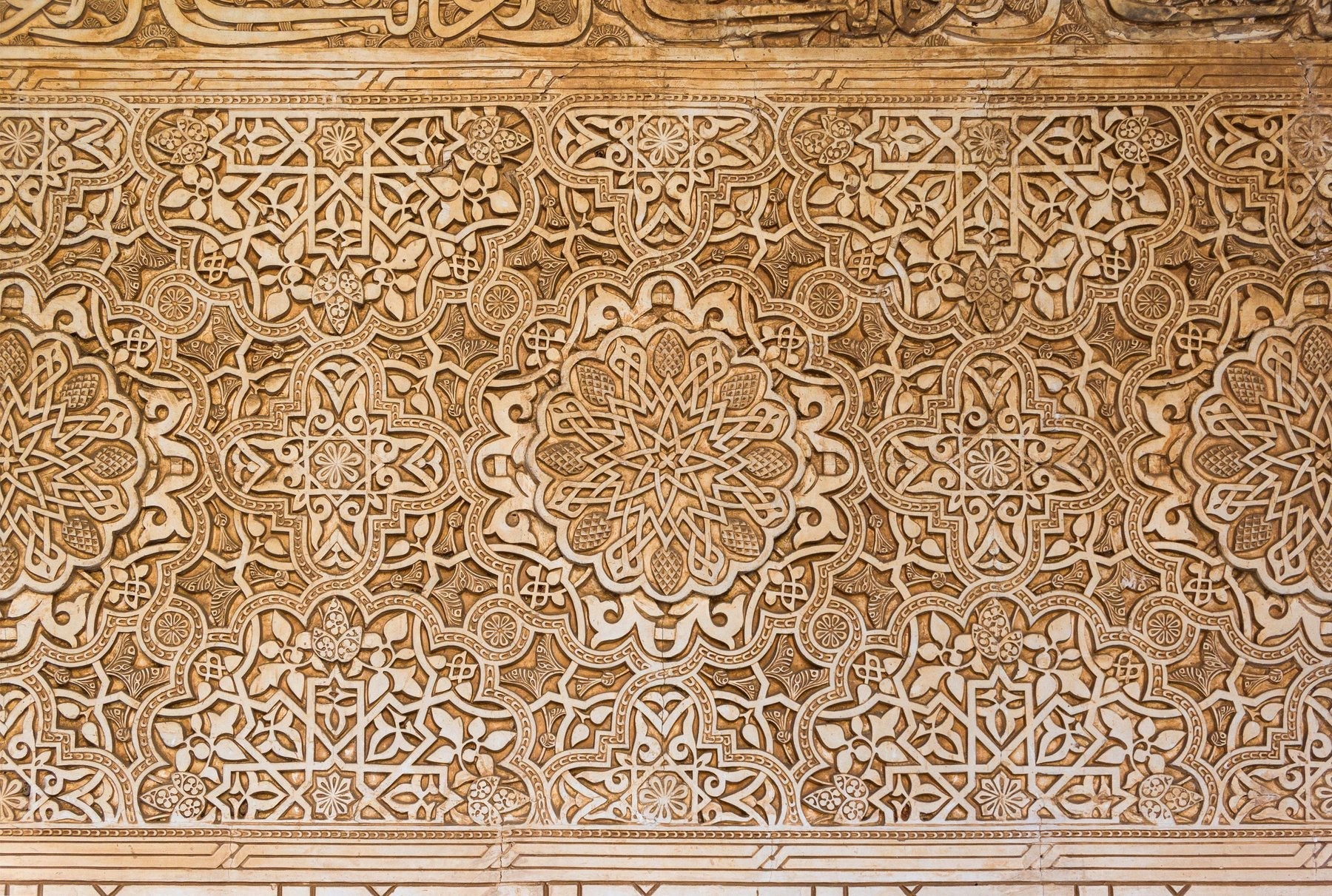
Carved arabesque and muqarnas dome, the Alhambra: Jebulon (CC0) and Sharon Mollerus (CC BY 2.0), via Wikimedia Commons, cropped and toned. Arabic De Materia Medica folio, 13th century: The Metropolitan Museum of Art, CC0. Juan de Mal Lara by Francisco Pacheco, c. 1599: public domain. Comentarios Reales title page, 1609: public domain. Diccionario de Autoridades, Tomo IV, 1734, folio 542: public domain scan, via Internet Archive. Yerba mate gourds: Marshallhenrie, CC BY-SA 4.0. Emolientero, Pueblo Libre, Lima: Miguel Angel Chong, CC BY 3.0, via Wikimedia Commons, cropped and toned. Evening pour and blend lineup: Menjunjes.
Sources
Real Academia Española, Diccionario de la lengua española, s.v. mejunje; Diccionario panhispánico de dudas, s.v. mejunje. Diccionario de Autoridades, Tomo IV (1734), headword MENJURGE; the passage sits in Book VIII of the first part of the Comentarios Reales (verified against the 1609 text, archive.org item primerapartedelo00vega). Joan Corominas, DCECH, s.v. menjurje (attestations: Mal Lara 1568, Fr. D. de Vegas 1590, Inca Garcilaso 1608 to 1609, also Cervantes, Quijote II.xxxix). Ley N° 30198 (Peru, 2014). Vendor figures: Edgar Sáenz, president, Federación de Emolienteros del Perú, on RPP, Economía Para Todos.