Vanilla Is an Orchid, and It Grows Wild in the Amazon
The bean in your pantry is not a bean. It is the cured fruit of a climbing orchid native to the American tropics — and Peru's own rainforest grows a version of it.
Once a year, a vanilla flower opens for a single morning. If nothing pollinates it before the afternoon, it closes, drops from the vine, and leaves no fruit behind.
Multiply that one-morning window across a whole plantation, flower by flower, by hand, and you have most of the reason vanilla is, by most accounts, the second most expensive spice in the world, after saffron. The rest of the reason is stranger. The plant is an orchid, and its homeland is not Madagascar. It is the American tropics, with wild cousins climbing through the forests of the Peruvian Amazon.
Not a bean at all
A vanilla bean is the seed pod of a climbing orchid, and orchids belong to one of the largest families of flowering plants on earth: tens of thousands of species, almost all of them grown for their flowers. Vanilla is the rare one the world grows to eat.
The pod is a fruit, botanically a capsule, and on the vine it is green, unremarkable, and almost odorless. It carries none of the scent you know until it is cured, dried and sweated over weeks until the aromatic compounds develop and the pod turns dark, supple, and fragrant. The name records where it was found. Vainilla is Spanish for "little pod," a diminutive of vaina, a sheath or scabbard, which is the shape the Spanish saw when they met the plant in the Americas.
Why one spice costs so much
In its native range, the vanilla orchid is pollinated by particular insects that evolved alongside it. Take the plant anywhere else, and for two centuries growers took it nearly everywhere, and the flowers open to nothing. No insect, no pod.
For a long time that made cultivated vanilla close to useless outside the Americas. The fix, as the accepted history tells it, came from a twelve-year-old. In 1841, on the Indian Ocean island of Réunion, an enslaved boy named Edmond Albius worked out how to pollinate a vanilla flower by hand: lift the small flap that divides the male and female parts with a sliver of wood, press them together, move to the next flower. A Belgian botanist had published a slower version a few years earlier, but Albius's method was quick enough to build an industry on, and it is still, in essence, the one used on nearly every vanilla flower grown today.
Somewhere, a person is walking a row of orchids at first light, pollinating each flower by hand in the few hours it stays open, then returning months later to pick and cure the pods one at a time. Vanilla is among the most hand-touched crops on the planet, which is why a real pod costs what it does, and why so much of the world reaches for a synthetic version instead.
Madagascar owns the story, not the plant
Ask where vanilla comes from and most people say Madagascar. They are right about today. The large majority of the world's vanilla now grows in Madagascar and the neighboring islands of the Indian Ocean, thousands of miles from where the plant started.
Where it started is the American tropics. The vanilla of commerce, Vanilla planifolia, was first cultivated in Mesoamerica, in what is now Mexico, long before it crossed any ocean; people there were flavoring cacao drinks with it centuries before Europeans arrived and carried it away. The genus as a whole is an American one, its wild species scattered from Mexico and the Caribbean down through Central America and across the north of South America. Madagascar grew the industry. It did not grow the origin.
Peru has its own vanilla
That southern reach of the family is the part the market story leaves out, and it runs straight through Peru. Botanists record several vanilla species native to the Amazon basin, among them Vanilla pompona and Vanilla odorata, climbing wild in the humid lowland forest. Growers and traders in the region call it plainly: vainilla amazónica, Amazonian vanilla, a fuller, headier, more floral relative of the Madagascar bean.
It grows in the same warm, wet forests that give the Amazon its other well-known fruits, including the camu camu that turns up tart and red in our own cups. A different plant, the same country, the same green lowland reach of Peru.
The most precious thing in the blend
Amazonian vanilla is the ingredient we would least like to run out of. It is the most precious thing in Dusk, a low-caffeine evening blend, where it sits behind apple, cinnamon, chamomile, and a base of Cusco black tea. Use 8g to a mug of about 300ml, six to eight minutes; sample it at six, since it turns tannic past eight. You taste it late — a honeyed, woody softness under the spice, the note that rounds the cup and keeps the whole thing from reading sharp.
The same vanilla appears in a different key in Gather, the caffeine-free blend made for company and best poured over ice, where it runs beneath camu camu, hibiscus, and berries. Two unlike cups, one rare thread through both. If you would rather meet the range at once, the Discovery Box pours all four.
None of which changes what vanilla is at the register: a small, dark, costly pod, native to the American tropics, with wild cousins in Peru's own forests.
Notes and sources.
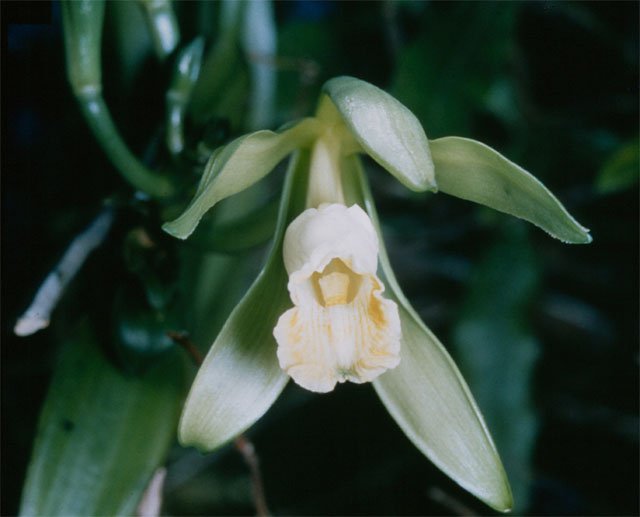
Standard botanical references and species databases: vanilla as an orchid, the genus's American range, and Vanilla pompona and Vanilla odorata among the species recorded in the Amazon. Documented horticultural history: the account of Edmond Albius and his 1841 hand-pollination method. "The second most expensive spice after saffron" is a widely repeated market claim, not a fixed rank. The vanilla orchid photograph is in the public domain, via Wikimedia Commons.
Menjunjes