What Is Camu Camu? The Amazon Fruit Too Sour to Eat
Almost nobody eats camu camu. Fresh off the branch it is so sour that even the people who harvest it rarely eat it whole; it gets juiced, pulped, frozen, or dried instead, which makes it less a snack than a raw material.
A shrub that spends the season underwater
Camu camu (Myrciaria dubia) is a shrubby tree of the western Amazon, native to Peru, Colombia, and parts of Brazil and Bolivia. It grows where almost nothing else in the orchard world would volunteer: the várzea and igapó, the seasonally flooded forests along the rivers, where the water rises with the rains (in places by eight or ten meters) and the trees stand in it for months at a stretch.
The fruit ripens during the Amazon's high-water season, when the shrubs stand partly submerged and harvesters reach them by canoe among the flooded branches: a canoe gliding between the crowns of half-drowned trees, fruit picked at eye level from branches that will hang far overhead once the river falls and the forest floor reappears. The flood, for this crop, is the road in.
Most of the world's camu camu still comes from Peru, and much of the crop is still gathered this way, from wild and semi-wild stands along the rivers of the lowland Amazon, though planted plots on the floodplain have spread since the fruit became an export.
Why it is so sour
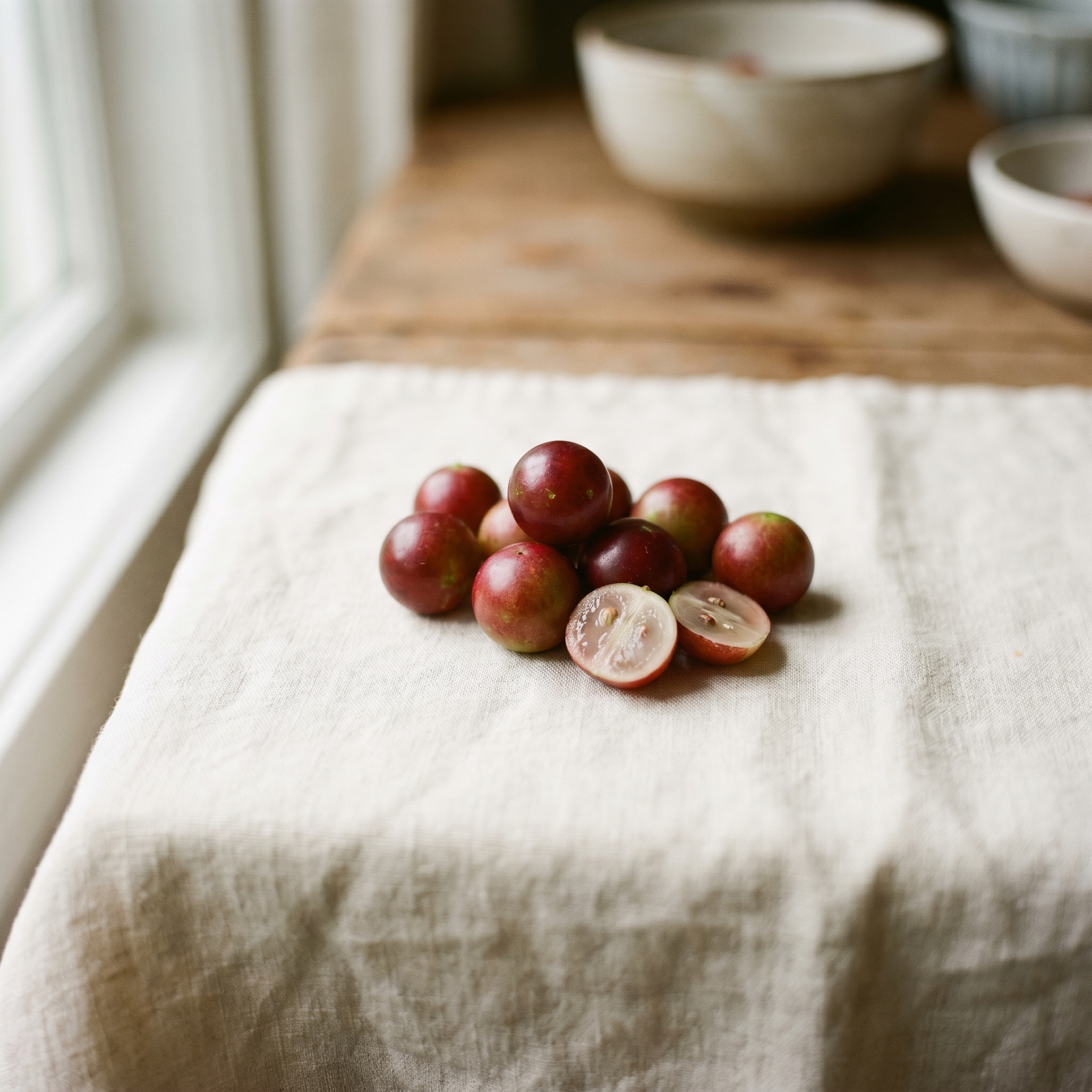
The fruit itself is small, a little larger than a cherry, with thin skin that ripens from green through red to a deep reddish purple, and pale flesh. Fresh, it is almost too sour to eat: somewhere between a lemon and an unripe grape, with a tartness that crosses the line from food to ingredient.
Part of the explanation is composition. Peer-reviewed measurements of fresh camu camu pulp typically find 2 to 3 grams of vitamin C per 100 grams (2 to 3 percent by weight), among the highest concentrations ever measured in a fruit. Vitamin C is ascorbic acid, and acid is the operative word: at that concentration it is part of what the tongue registers, alongside the fruit's other organic acids. Oranges, for comparison, come in around 0.05 percent in standard food-composition tables. The fruit does not taste forty to sixty times more sour than an orange, because the natural sweetness in fruit balances acid, but it does land brighter, more astringent, more concentrated.
Acidity on that scale changes what a fruit is for. Nobody builds a fruit bowl around it; cooks and blenders build around it instead, the way a kitchen builds around tamarind or a bar builds around lime.
Ordinary in Loreto
Along the rivers of the Peruvian Amazon, around Loreto and Ucayali, ribereño communities harvest camu camu from the flooded forest. Intensely sour, it was little eaten until recent decades, when it became part of the region's food and market economy as juice, pulp, and exported powder.
In Iquitos, the region's river capital, it is an everyday flavor rather than a delicacy: juice at the market stall, cremolada (a blended fruit ice) on a hot afternoon, bags of frozen pulp sold the way frozen berries are sold anywhere else. Camu camu in Loreto is ordinary, seasonal produce, roughly what wild blackberries are to Oregon. Yet exporters have spent two decades dressing the fruit up as a jungle miracle, and the people who pick it would not recognize the costume.
The name, at least, survived the trip. When the fruit left the region, first as frozen pulp and later as powder, the Peruvian word simply went with it: camu camu is what it is called in Iquitos and what it is called on an ingredient panel in Los Angeles. When we printed the pouch there was nothing to decide. The world had already agreed on the name.
What it does in Gather
We blend camu camu into Gather, the caffeine-free blend made for company, where it works alongside hibiscus as the tart line. The rest of the roster is soft fruit and florals: cranberry, blueberry, strawberry, Amazonian vanilla, and butterfly pea flower, which steeps mild and leaves the color of the cup to the hibiscus. Camu camu and hibiscus together are what keep all that fruit from going flabby; the acidity holds the sweetness up the way it does in a good jam.
In the cup, Gather pours a deep berry red, almost wine-like, with a sweet-tart balance, notes of strawberry and plum and blueberry, and a silky finish. It is the most forgiving blend we make (it does not really oversteep), and the one we most often cold-brew by the pitcher when there are more than two people in the kitchen: 50 grams to about 1.4 liters of cold water, overnight in the fridge, then strained over ice.
Camu camu also keeps particular company on our shelf, beside other ingredients that arrived with a place attached: the cardamom grown around Villa Rica, in Peru's selva central, and boldo, an after-meal leaf from central Chile. If the tartness described here sounds like your kind of cup, Gather is the direct route. If you would rather taste your way across all four blends first, the Discovery Box carries each in a sampler pouch, and Gather is the deepest-colored cup of the four.
Notes and sources.
The 2-to-3-percent vitamin-C figure is the finding of peer-reviewed food-chemistry measurements of fresh camu camu pulp, and the orange comparison comes from food-composition tables. The botany and the high-water harvest come from the agronomy and domestication literature on Myrciaria dubia, much of it produced in and around Iquitos, where Peru's Amazon research institute has studied the species for decades. The river-rise figure is the commonly cited range for the seasonal flood pulse of the western Amazon; it varies by river and by year. The picture of the fruit's place in the Loreto economy, little eaten fresh and traded as pulp and powder, comes from ethnographic and market studies of ribereño communities.
Menjunjes