What Is Butterfly Pea Flower? The Blue Petal in a Berry-Red Cup
Of the seven ingredients in Gather, butterfly pea flower is the only one most people recognize on sight and struggle to describe by taste.
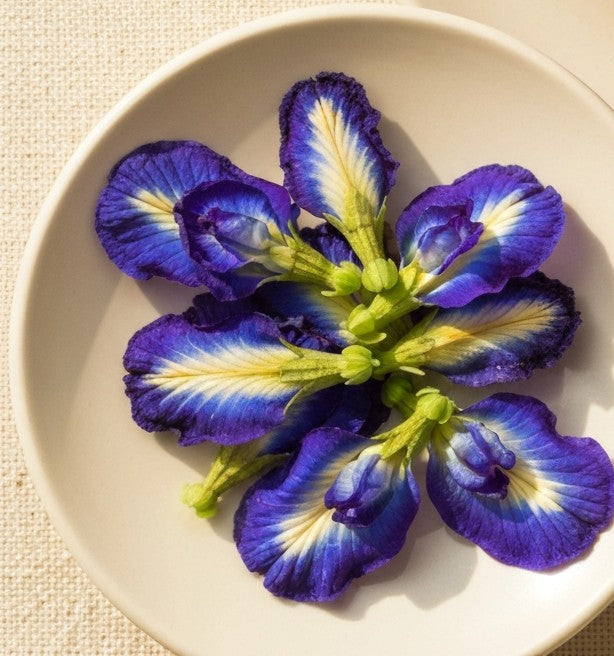
The plant is Clitoria ternatea, a climbing vine in the legume family, native to Southeast Asia. The bloom is small, vivid blue, and almost impossibly delicate: the kind of thing you would walk past in a garden without stopping, unless someone told you what it does to a pot of water.
Where it comes from
Butterfly pea climbs fast and thrives with little care. It grows in humidity, sun, and ordinary soil, and it has traveled well beyond its home range; it now turns up in gardens and field margins across the tropics. Farmers plant it for reasons that have nothing to do with the kitchen. It is a legume, so like its cousins the beans it returns nitrogen to the soil it grows in, and across much of the tropics farmers also use it as forage and a cover crop.
The kitchen story belongs to Southeast Asia. In Thailand, the petals color sticky rice and desserts. In Malaysia, they give nasi kerabu, a herbed rice dish, its signature blue. Across the region, the dried flowers are steeped on their own as a caffeine-free infusion, valued less for flavor than for what they bring to the eye. Those uses are old, well documented, and still everyday practice. In the last decade the petals have traveled again, into bakeries and bars far from Bangkok, because this flower is one of the few places a cook can get a true blue from a plant rather than a bottle.
Ours is tropical-grown, dried whole, steeped whole.
The famous blue, and what it is
The blue is pigment, not dye. Butterfly pea petals are unusually dense with anthocyanins, the same family of water-soluble pigments that makes blueberries blue and red cabbage purple. The flower's particular anthocyanins are built on delphinidin, a molecule named for the delphinium and responsible for some of the deepest blues in the plant world. Anthocyanins are sensitive to acidity, a point covered in published food chemistry. In neutral water they hold a deep blue-violet. As the liquid turns more acidic, their structure shifts and the color moves through purple toward pink and red. It is reversible chemistry, the same reason red-cabbage water changes color when vinegar hits it, and it is why photographs of plain butterfly pea tea look faintly unreal: the blue seems impossible, and it is not.
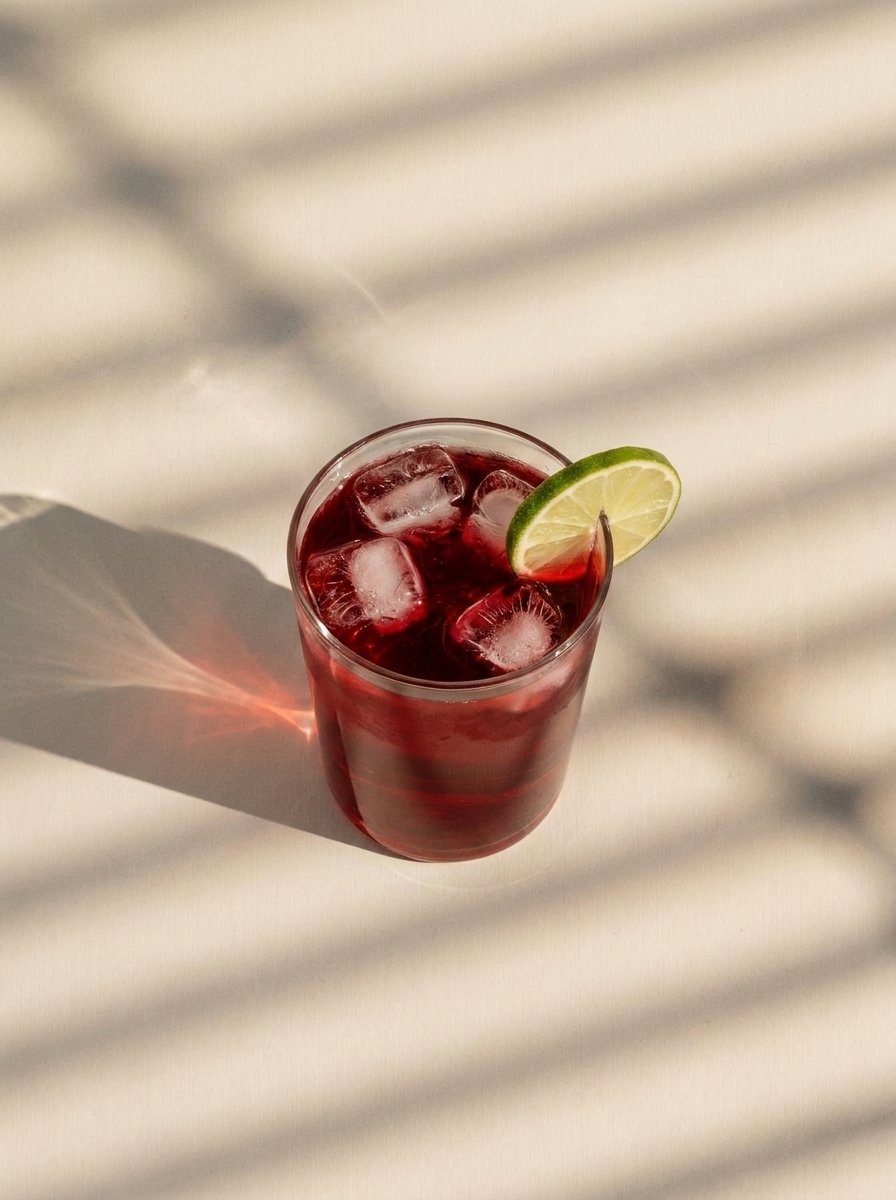
In a blend, the chemistry does not wait. Gather sets butterfly pea flower alongside hibiscus and camu camu, and both are naturally tart; the moment hot water hits the pot, they acidify the brew, and the acid shifts the pigment toward red before you pour. So Gather does not brew blue. It pours a deep berry red — dark cherry, almost wine-like, the color our tasting notes call guinda. The flower's chemistry has already happened by the time the cup reaches the table. What it leaves behind is depth: the difference between a red that looks like juice and a red that looks like wine.
If you have only ever seen the flower in photographs, the spectacle belongs to a single petal in plain water. In a built blend, the same reaction happens in the pot, and the payoff is a deeper color.
What it tastes like
On its own, butterfly pea is mild. Earthy, slightly vegetal, with a softness that reads more as texture than flavor. Nobody blends it for the taste, and nobody should pretend otherwise.
In Gather, the flavor comes from the other six names on the panel. Camu camu brings a bright tartness up from the Amazon; hibiscus adds its floral acidity; cranberry, strawberry, and blueberry carry the fruit; Amazonian vanilla sits underneath, warm and round. Brewed, the cup lands sweet-tart and silky, with strawberry, plum, and blueberry on the palate and a long finish. The butterfly pea's contribution is smaller than any of that: a little body in the texture, and a depth of color no berry manages alone.
How to brew it
Gather takes 8 grams per large mug, about 300 milliliters, in water straight off the boil, for 8 to 10 minutes. Taste it at eight; give it the full ten if you want the color and the fruit deeper. It is forgiving. With no tea leaf in it to turn tannic, it is hard to oversteep; the botanicals simply deepen the longer they sit.
Iced is where it shows best. Brew it at double strength and pour it over ice, or cold-brew 50 grams in a large pitcher (about 1.4 liters) overnight. It is caffeine-free; if caffeine is the thing you check labels for, this and Rooted are the two that carry none at all. Timings, water notes, and methods for the other three live in the brewing guide.
A flower for company
Gather is the blend we make for company: the pot that goes on when someone stays past the hour they meant to leave. Butterfly pea flower is one of seven names on its panel, and the one you see before you taste.
A 200-gram bag of Gather is $32, which comes to about 25 large mugs at the dose above. If you would rather meet all four blends before committing to one, the Discovery Box is $40 and carries a 50-gram pouch of each.
Menjunjes